What is a Foveon sensor?
Let's start with a bit of Sigma and Foveon history…
Although there were long gaps between the Mark-I, SA-1 and SA-300 models, throughout the 1990s and early 2000s, Sigma kept their SA line of auto-focus SLRs up-to-date with fairly regular new camera launches which gave them a pretty well developed autofocus SLR platform on which to base their very first DSLR, the SD9 of 2002. And this is were we really get to the point of this page! Because between 2002 and 2016 the defining characteristic of all Sigma digital cameras was their unique* Foveon sensor technology.
The Foveon X3 sensor was invented by Richard "Dick" Merrill, who founded the Foveon company in 1997 to develop the idea. Sigma was the only company to use the Foveon's technology in a really serious way, and in 2008 Sigma bought Foveon, which effectively reduced the possibility that anyone else would ever use it effectively to zero.
The SD Quattro and SD Quattro H cameras of 2016 were Sigma's last Foveon cameras. In 2019 they launched the FP, an L mount mirrorless camera with a conventional old Bayer sensor. But while the sensor may have been conventional, with the FP Sigma proved they were still determined to doggedly make unique cameras that attempted (with varying degrees of success) to completely rethink what a digital camera could and should be. Sigmas current camera, the BF continues this tradition.
* Actually the Foveon sensor technology isn't 100% unique to Sigma: there is one camera with a Foveon sensor not made by Sigma, and that's the ill-fated Polaroid x530 of 2004.
So what makes Foveon different?
In order to understand what makes a Foveon X3 sensor so different you first need to understand something about how other colour digital sensors work.
Bayer sensors
Most colour digital sensors place something called a Bayer filter over the sensor. A Bayer filter (invented by Bryce Bayer in 1976 while working for Kodak) is a mosaic like array of red, green and blue colour filters that ensures each pixel is sensitive to just one colour of light:
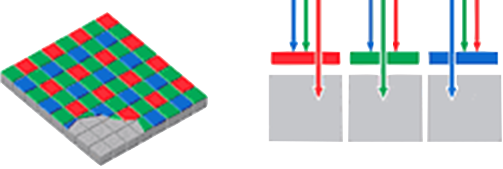
The Bayer filter uses a simple 2x2 pixel pattern which of course contains a repeating pattern of 4 pixels, but there are three primary colours of light! Green is used for the 4th pixel to mimic the fact that the human eye is more sensitive to green light than it is to red or blue light. But each pixel on a computer display consists of 3 sub-pixels, one each for red, green and blue light, so to convert the data that comes from a digital sensor with a bayer filter in a file that can be displayed on a computer display, interpolation is used to supply each pixel's 2 missing colour values. This process is usually referred to as "demosaicing".
This means that even when you convert the data from a 10 megapixel sensor into a 10 megapixel JPEG image, a huge amount of interpolation is needed. That's right… 2/3s of the data in digital image file is conjured out of thin air by the demosaicing algorithms! This is a fact that passes many people by completely. (This is understandable given that in the early days of digital cameras even more interpolation was often used to increase the number of pixels, and the image files from the cameras that did not do this were often described as un-interpolated.) But never-the-less, they really are heavily interpolated, even though you could describe this interpolation as colour interpolation rather than spatial interpolation.
There are a number of variations on the Bayer filter theme. Fujifilm in particular are famous for their SuperCCD and X-Trans sensors. But these still involve placing a colour filter array infront of the sensor to render each pixel sensitive to a single colour of light, with interpolation used to estimate the missing two values. The only real difference is the mosaic pattern used.
Foveon X3 sensors
Foveon X3 sensors use a completely different principle. They rely on the fact that different wavelengths (i.e. colours) of light penetrate silicon to different depths. 3 sensor layers are stacked in a block of silicon. Blue light penetrates the least and so only reaches as far as the first layer. Green light penetrates further and so reaches the middle layer. And red light penetrates the farthest and so only red light reaches the bottom layer:
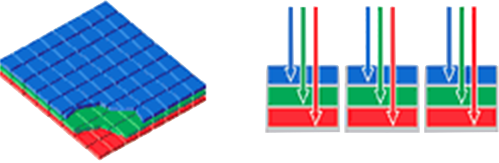
So this means that each spatial pixel is sensitive to all colour wavelengths. This might make you think that the raw data from a Foveon X3 sensor can be displayed on a computer screen as the final JPEG image, but unfortunately life (as is so often the case!) is more complicated. The thing is that the top layer is the stack isn't just getting blue light, it's actually getting all three colours of light. The middle layer is getting both red and green light, and only the bottom layer is actually getting a single light colour. So even though colour interpolation is not needed as it is with a sensor with a Bayer colour filter array, very complicated mathematics involving an intimate knowledge of exactly how light penetrates silicon, is still needed.
Advantages of the Foveon sensor
The lack of colour interpolation needed to convert the raw data from an Foveon sensors means that, pixel for pixel, a Foveon sensor can resolve at least twice the detail of a Bayer filter sensor. And a Foveon sensor responds to colour in a way that is far closer to the way both film and the human eye responds to colour. All that complicated mathematics results in it's own quirks and eccentricities, but never-the-less the images produced by Foveon sensors have a subtly distinctive look that is very addictive once you acquire the taste. Addictive enough to make a small but dedicated band of enthusiasts put up with a whole mess of quirks and eccentricities. Speaking of which…
Disadvantages of the Foveon sensor
All that complicated mathematics I previously mentioned essentially involves throwing away the green and red light that hits the top sensor layer, and the red light that hits the middle layer. And ignoring that light results in one of the most commonly mentioned problems with Foveon sensors: their low level of light sensitivity and poor performance in low light and at high ISO settings. Foveon sensors are best used at their base ISO rating.
Foveon sensors also tend to have lower dynamic range than Bayer sensors. And stacking 3 sensors on top of each other means you're throwing a great deal of data around which makes cameras with Foveon sensors generally slower than equivalent cameras with Bayer filter sensors.
Finally, the fact that Foveon sensors have a lot of really weird quirks (try putting a light source in the frame with a Foveon camera to get some really bizare and ugly bright green flare effects!) can leave even the most loyal Foveon enthusiasts frustrated.
The fact that so few cameras have ever used Foveon sensors means that it's difficult to get companies that make RAW development software to support Foveon cameras, which means that you may well find your only option is Sigma's own Sigma Photo Pro software, which can massively complicate your workflow if you're used to something like Adobe Lightroom. Having said that, early Sigma cameras, up to and including the SD14, are fairly well supported in Adobe software, and the most resent Foveon cameras (i.e. the SQ Quattro cameras) can produce .DNG raw files that can also be imported by Lightroom.
All these problems are exacerbated by the fact that there has only ever been one company making these sensors, while Bayer filter sensors are being developed in a highly competitive environment by many companies with huge financial resources behind them. Early Bayer filter sensors were dogged by all sorts of horrible problems too, but that competitive market meant vast resources were plowed into solving those problems.
That looks like a far longer list of disadvantages than advantages, doesn't it? But the mere fact that a dedicated band Foveon loyalists are will happy work around all these problems just to get that "Foveon look" should tell you a lot about just how much people value it!
How many megapixels?
The lack of colour interpolation needed in order to process Sigma Foveon X3 files into image files you can view on a computer display genuinely does enable a Sigma camera to resolve much more detail than Bayer filter sensors with a similar number of megapixels, and this has always presented Sigma with a considerable marketing problem. Rightly or wrongly (and mostly wrongly!) the pixel resolution of a camera's sensor is a huge part of why we choose one digital camera over another. So if Sigma marketed a camera with a notional 5 megapixel Foveon sensor against cameras with 5 megapixel Bayer filter sensor they would be genuinely and hugely under selling its capabilities.
Sigma's approach is to count to each pixel in each of the sensor layers and add them all together. This means they report that notional 5 megapixel Foveon sensor as having 15 megapixels. Given that each pixel on a Bayer filter sensor is sensitive to a single colour, it's impossible to deny the logic of counting each single colour pixel in Foveon sensor too. The problem is, that tends to over report the capabilities of Foveon sensors. Most reviews of Foveon sensor cameras tend to agree that they can resolve as much detail as a Bayer filter sensor with twice, not three times, the number of pixels.
The situation is further complicated by the 4th and final generation of Foveon sensors, the Foveon X3 Quattro sensors. These sensors have a much high pixel count for the top layer than previous Foveon Sensors, but the middle and bottom layers only have one pixels for every 4 in the top layer. Sigma regularly quote the Bayer equivalent resolution for these sensors as twice the pixel count of the top layer, without ever really providing a mathematical principle for doing so.
Also, all sensors have a small number of pixels around the edge that cannot be used as they are obscured by the construction of the sensor. The pixels that can actually be used is usually referred to as the "effective" pixel count. Foveon sensors seem to have a larger number of these unusable pixels and Sigma have always had an unfortunate habit of using the total pixel count rather than the effective pixel count in their specification sheets. This is why Sigma regularly refer to their (for example) Merrill sensor as having 15.4x3, or 46 megapixels, while I tend to refer to is as a 14.8x3, or 44.3 megapixel sensor.
But in todays world of sensors ultra-high pixel resolutions, practically every sensor made has way more resolution than 98% of users will ever need, and especially given the difficulty in usefully counting the pixels of a Foveon sensor, perhaps the best approach is to not even try to compare Foveon pixel counts to Bayer pixels counts. Particularly with 3rd and 4th generation Foveon sensors, forget about pixel counts, and just drink in the amazing details that makes you feel you can just zoom and zoom into your images!
Sigma Foveon sensor generations
There are basically 4 generations of Sigma Foveon sensors. I thought it would be quite useful (for me if no one else!) to build a table summarising these generation:
| Generation | Sensor size | Crop factor | File resolution | Top layer megapixels | Total megapixels | Camera models |
|---|---|---|---|---|---|---|
| 1st | 20.7x13.8mm | 1.7x | 2268x1512px |
|
|
|
| 2nd | 20.7x13.8mm | 1.7x | 2640x1760px |
|
|
|
| 3rd (Merrill) | 23.5×15.7mm | 1.5x | 4704×3136px |
|
|
|
| 4th (Quattro) |
APS-C version 23.4×15.5mm |
1.5x | 5424×3616px |
|
Note: Sigma claim that the APS-C Quattro sensor has a resolution comparable to a 39mp Bayer sensor (i.e. double the resolution of the top layer). |
|
|
APS-H version 26.7×17.9mm |
1.3x | 6192×4128px |
|
Note: Sigma claim that the APS-H Quattro sensor has a resolution comparable to a 51mp Bayer sensor (i.e. double the resolution of the top layer). |
|